USA Coliving Finder
A trust-first coliving marketplace — launched and focused on Colorado first, built to scale state by state as demand grows. Find the right room. Find the right renter.
The problem: finding a furnished room is a guessing game
- The problemSomeone looking for a furnished, month-to-month room faces scams, surprise costs, and listings that never say who they'd be living with. Someone with a shared home has nowhere to list it and no way to verify who they're opening the door to. Ten years of inquiries at Denver Coliving showed me both sides.
- Who it's forTwo people: the renter moving to a new city who wants a ready room and verified people; and the owner sharing their home who wants to fill a room with someone compatible without becoming a full-time manager.
- What I didFounder and product designer: strategy, information architecture, renter and owner flows, UI, brand, and copy — designed and built end to end with AI as the build tool.
- The solutionTrust first: identity verification on both sides, one application form, direct messaging, all-inclusive month-to-month pricing — and the platform never steps between the two parties; each owner attaches their own lease.
- ResultLive and focused on Colorado first. One product, the same in every state, ready to grow market by market.
One home proved the model. One state builds it.
Ten years of Denver Coliving proved that calm, all-inclusive coliving works — and that the demand reaches well beyond one city. A marketplace is different: it needs enough homes and renters in one place. So the product is the same in every state, and the launch is focused on one. Colorado first.
Denver Coliving
One seven-room shared home, lived in for nearly a decade. The proof that calm, all-inclusive coliving works.
USA Coliving Finder
Launched and focused on Colorado first — the market I know best, where every decision gets tested before growing.
Same product, more markets
The same product and the same trust model in every new market.
The core design problem
How do you make finding a room — or a renter — in a shared home as clear as booking a hotel, without the platform taking on what belongs to each owner? A renter in Denver and an owner in Atlanta should be able to use the same product — and trust it the same way.
Built for coliving
General listing sites treat a room in a shared home like any apartment. This one asks the questions coliving actually raises: who lives there, what the monthly amount covers, and how the house runs.
Owner's own documents
The platform doesn't hand out leases. Every owner uploads their own documents; the platform provides one application form.
Colorado first
Starting with Colorado, growing from there.
Two sides of one marketplace
Dani, 31
Arrives from out of state with a start date and no time to furnish anything. Wants a ready room near the hospital, one predictable monthly amount, and housemates who have been verified — without learning a new city's rental scams first.
Goals
- A room that's ready the day she lands
- Predictable all-inclusive price
- Trustworthy housemates & landlord
Fears
- Out-of-state scams & sight-unseen risk
- Hidden costs & long lock-ins
- A lease that outlasts her contract
The landlord / manager
Owns or manages a coliving home in Colorado. Wants verified tenants and a clear process — without the hassle.
Goals
- Fill rooms with screened, compatible tenants
- Save hours with reliable screening and verification built in and automated
- Low turnover, minimal vacancy gaps
Fears
- Unverified applicants
- Vacancy between tenants
- Poor-fit residents
A marketplace only for coliving, launched in one place
Two decisions define the project. First, build for one kind of housing — furnished rooms in shared homes — so everything a renter or owner needs in order to decide is built in: who lives there, what the monthly amount covers, the cleaning schedule, verification on both sides. Second, launch in one place: Colorado first, prove it works, grow from there. The platform verifies, connects, and keeps pricing predictable — and leaves the documents with the people they belong to.
What the platform does Same everywhere
Identity verification on both sides, one application form, direct renter-to-owner messaging, and all-inclusive, month-to-month pricing.
- Renter and owner verification
- One standard application for everyone
- Rent goes directly to the owner
What the owner does Their own documents
Every owner uploads their own lease and house rules. The platform never hands out leases or steps between the two parties.
- Uploads their own lease
- Sets their own house rules and cleaning schedule
- Talks directly with the renter
One site, two front doors, one shared core
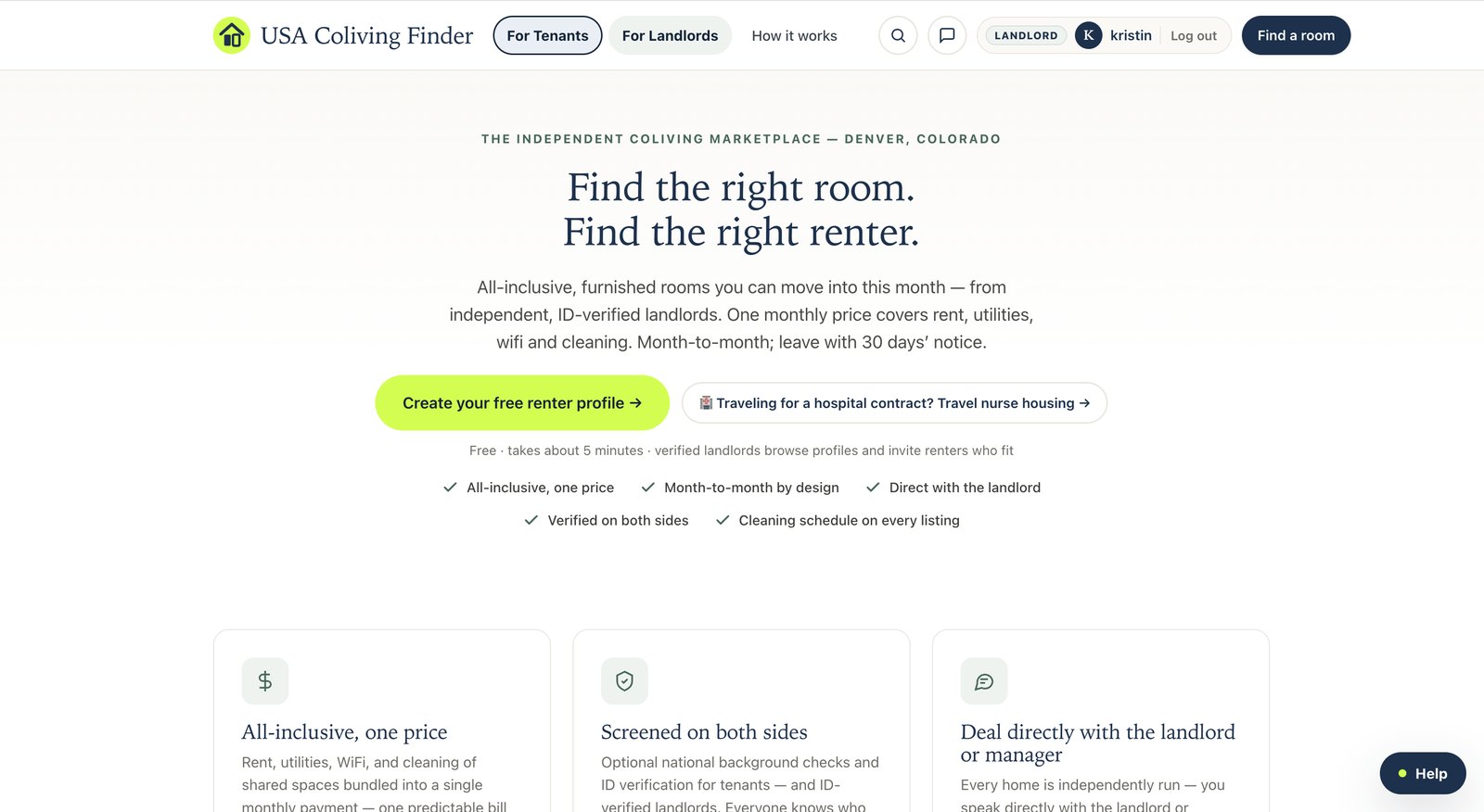
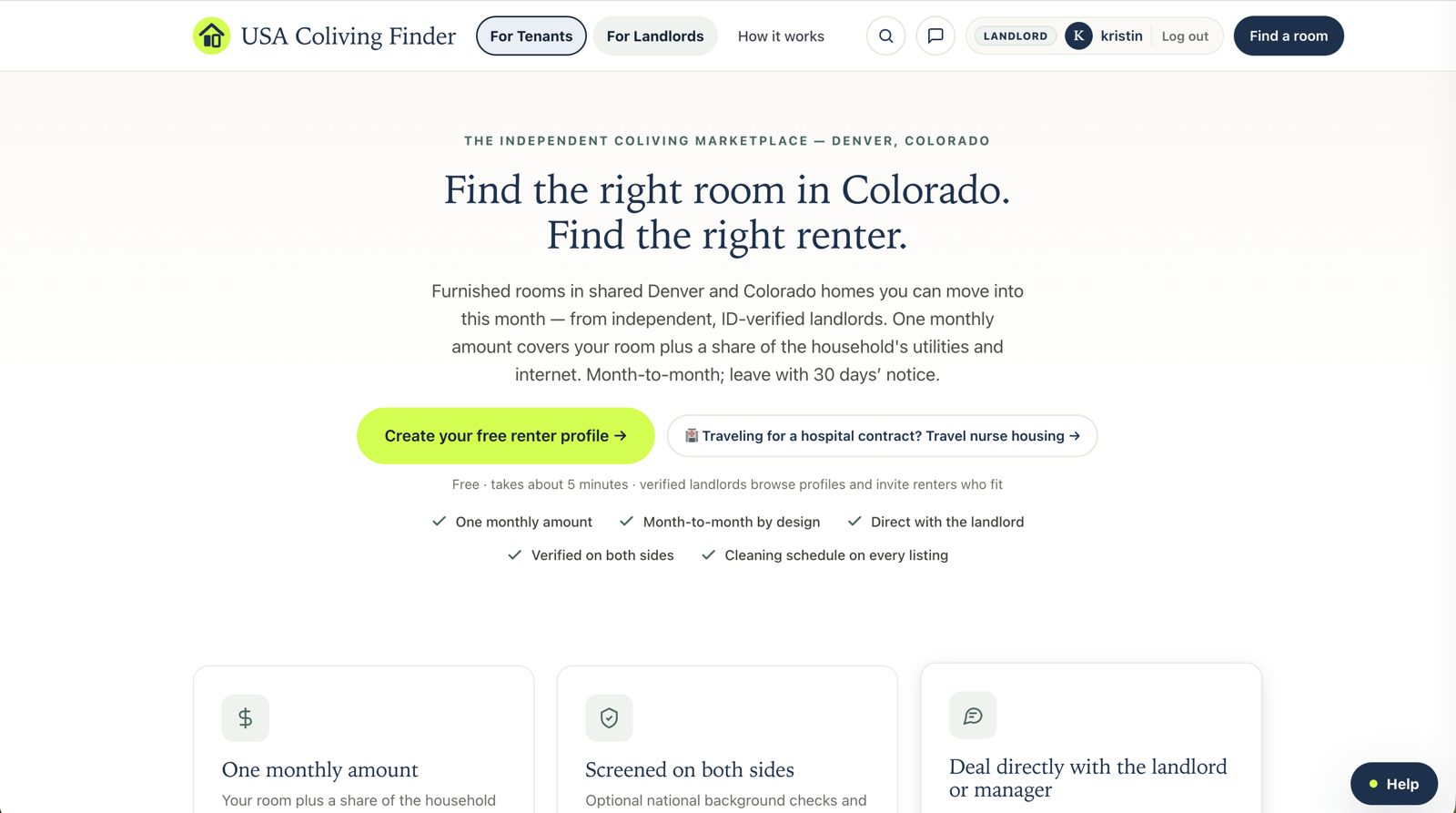
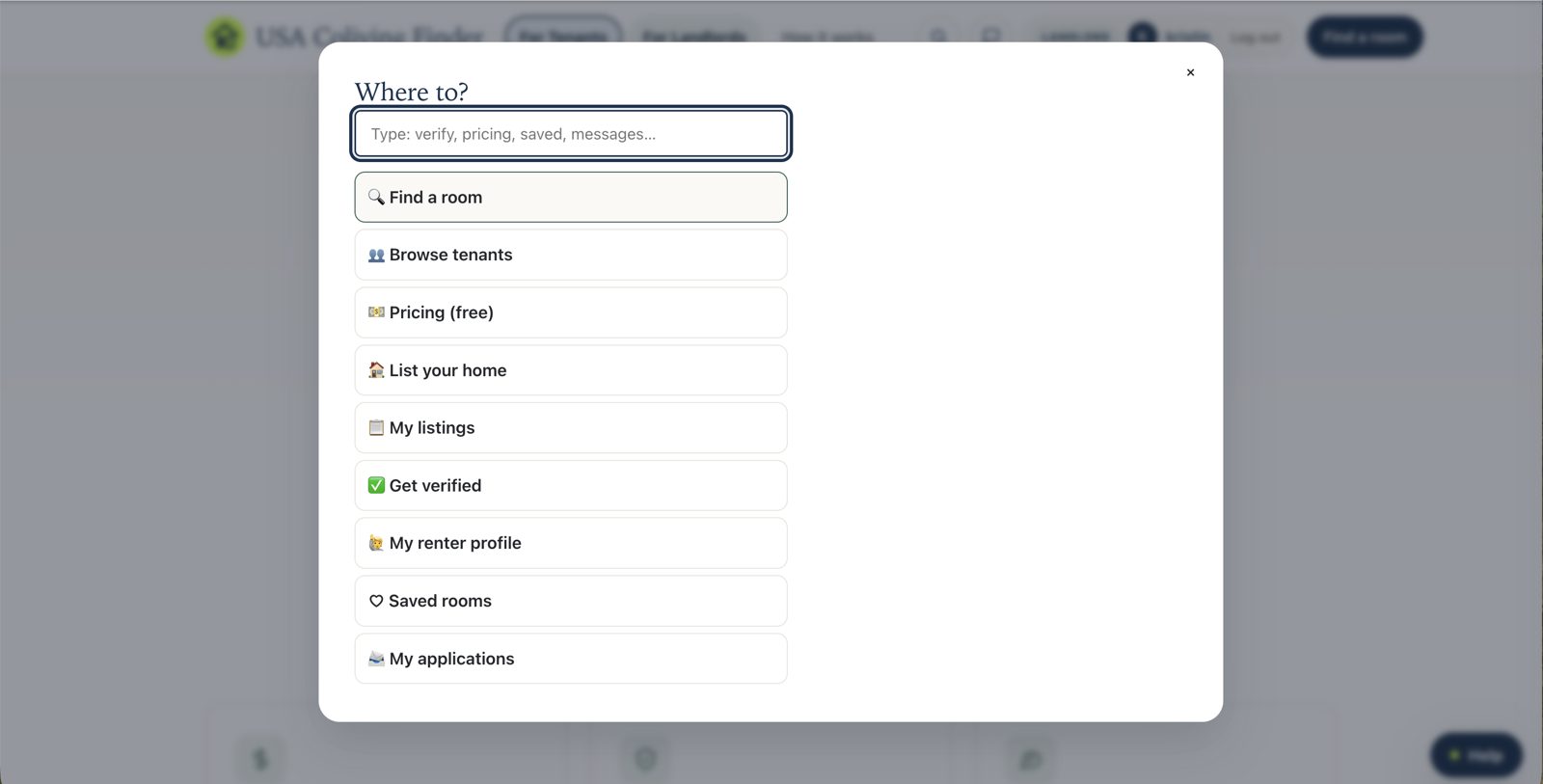
Renters and owners enter through different doors — Find a room, Find a renter — then share everything beneath them: how it works, pricing, verification, documents, messages, and applications. Each side follows its own path through one product.
Search
By city, price, and move-in date.
Listing
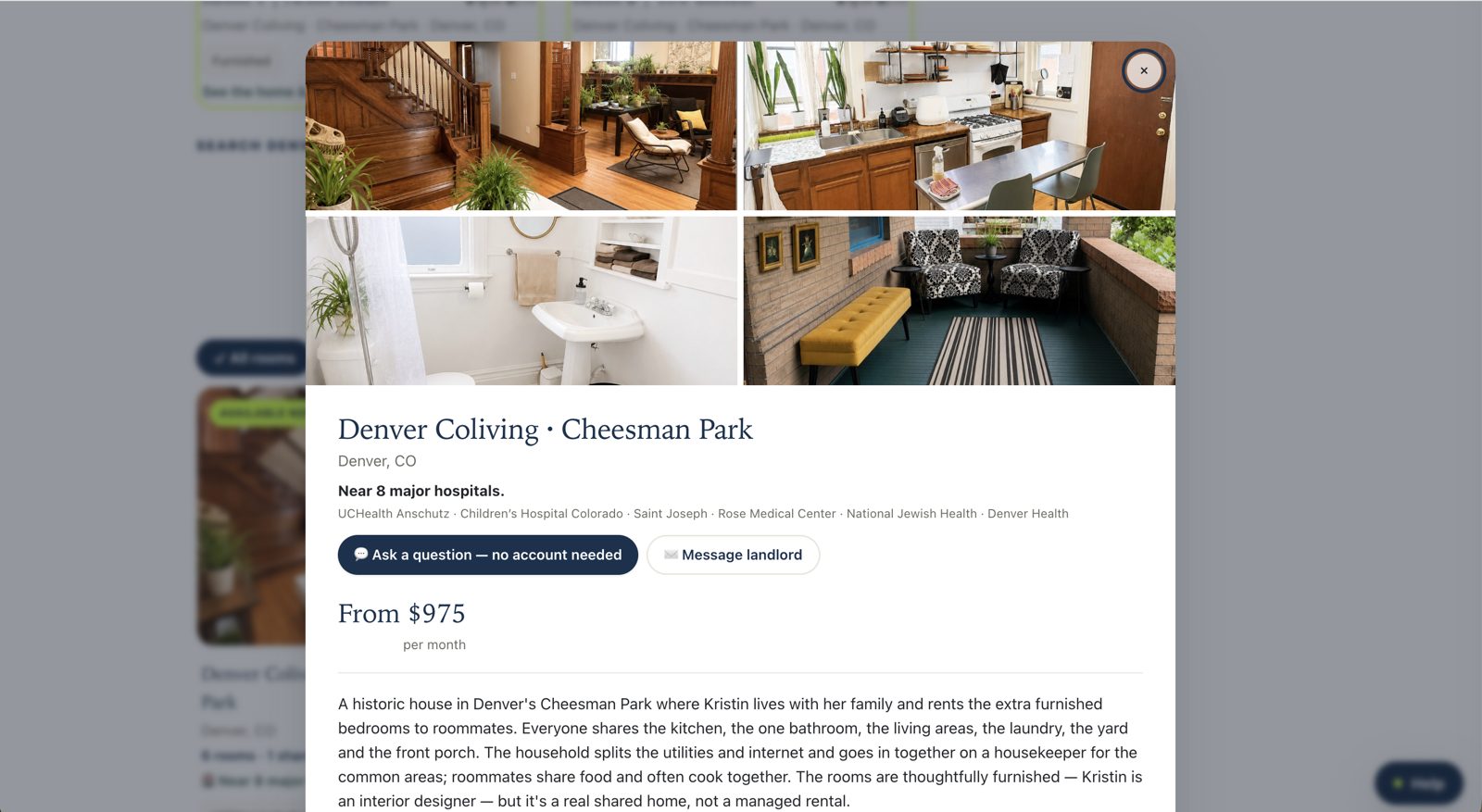
All-inclusive price, house rules, owner documents.
Verify
ID verification, with an optional background check — the biggest "yes" signal.
Apply / message
Apply on the listing or talk to the host directly.
Move in
Prorated first month; 30-day notice ending month-end.
List free
Listing a home is free.
Add rooms
Photos, pricing, house rules, and the owner's own paperwork.
Review & search
Verified applicants in; search renter profiles too.
Place tenant
First qualified, soonest move-in — keep gaps small.
Boosts & billing
Listing is free; featured boosts and photo polish are optional extras.
Fair on day one — and built to keep rooms full
Four rules make the model predictable for renters and keep vacancies short for hosts.
Prorated first month
Move in after the 1st and you pay by the day. No surprise full month — trust built up front.
30-day notice, month-end
Tenancies end at month-end so rooms turn over cleanly for 1st-of-month move-ins.
Fill-as-open or reserve
Rooms fill as they open to cut costly gaps; hosts who want a tenant lined up early can accept advance reservations.
Verification as an advantage
ID and background checks framed as the renter's fastest path to "yes" — not a hurdle.
One system, scaled — not rebuilt
USA Coliving Finder extends the Denver Coliving visual language into a full design system — tokens and components built once so the product shipped fast and stays consistent as it grows.
Color tokens (shared brand)
Core system
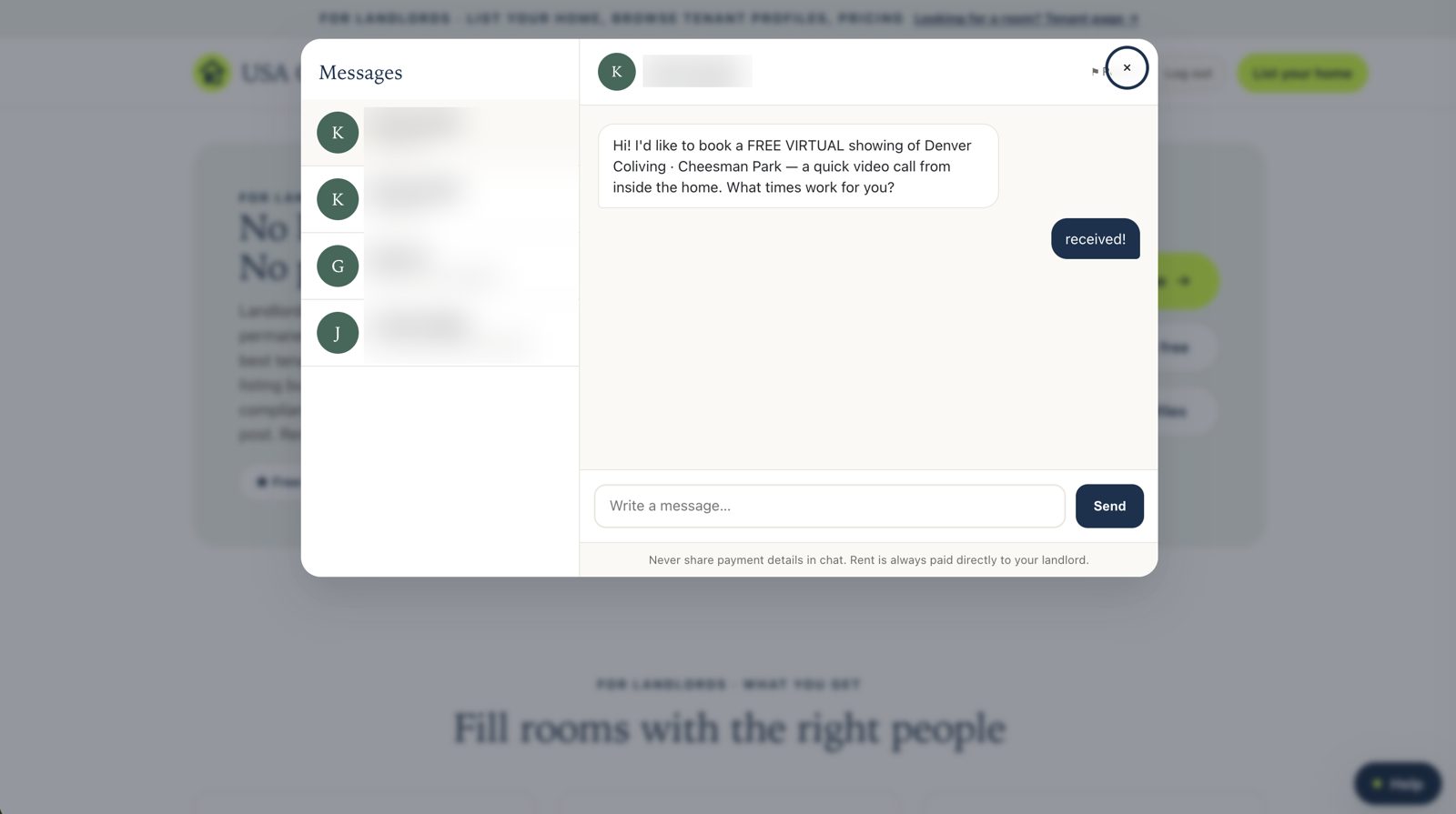
Pill chips, rounded cards (~16px), two-pane layouts (messaging, dashboards, tenant search), verification badges, primary/lime/ghost buttons — Georgia headings, system-sans body, fluid clamp() sizing.
New for the marketplace
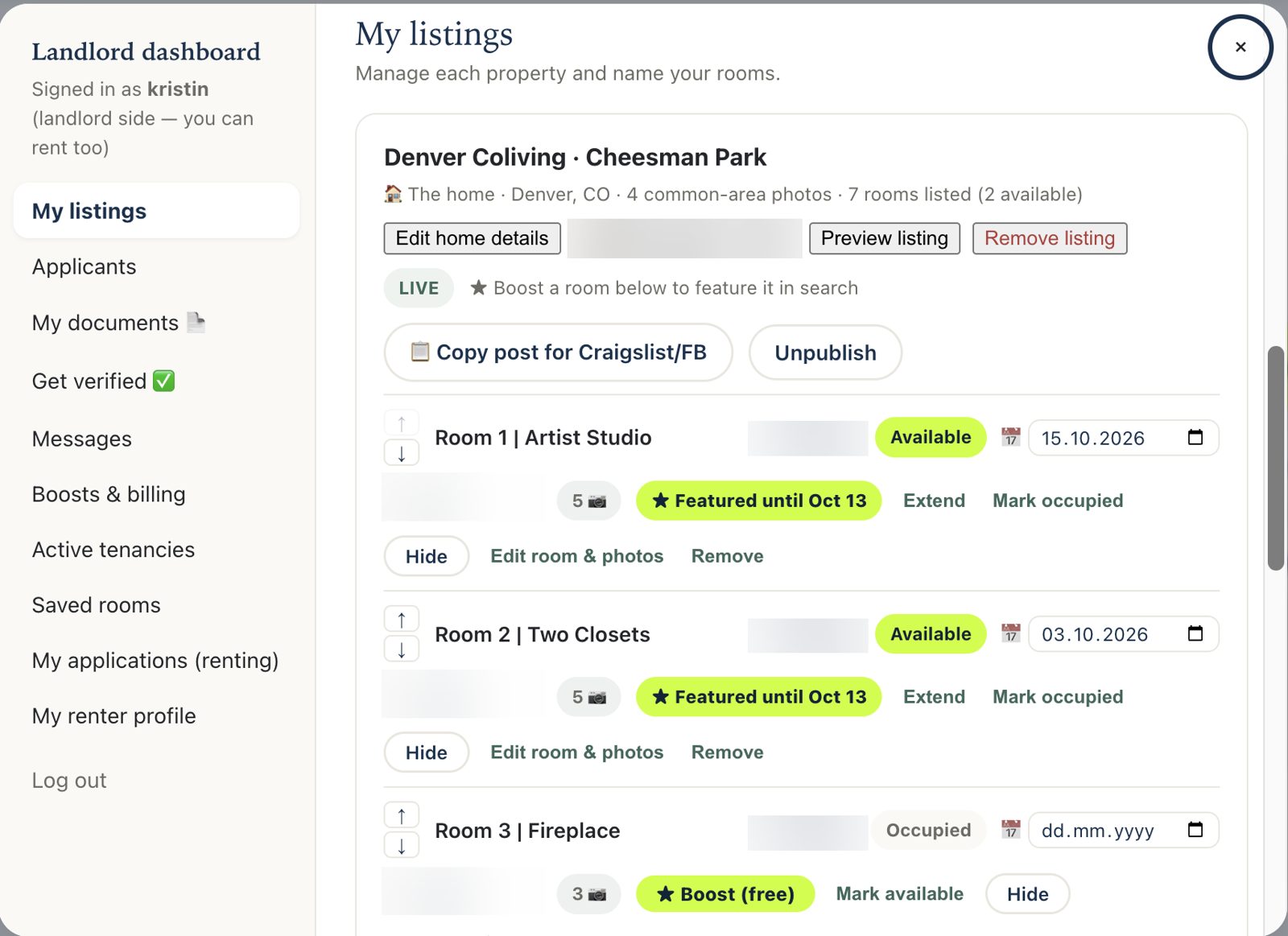
Renter profiles, filtered renter search, owner document upload, the standard application, the verification center, and the landlord dashboard.
A brand built to scale that still feels calm and local
Wordmark
The Denver Coliving wordmark, extended to a marketplace identity — same Georgia type and lime accent, so the family reads as one brand (Denver Coliving → USA Coliving Finder).
Voice — calm, plain-spoken
- "Find the right room. Find the right renter."
- "Calm, all-inclusive homes — and housemates you can trust."
- "We're making good rooms easy to find."
- "Fair on day one — and built to keep rooms full."
The product, annotated
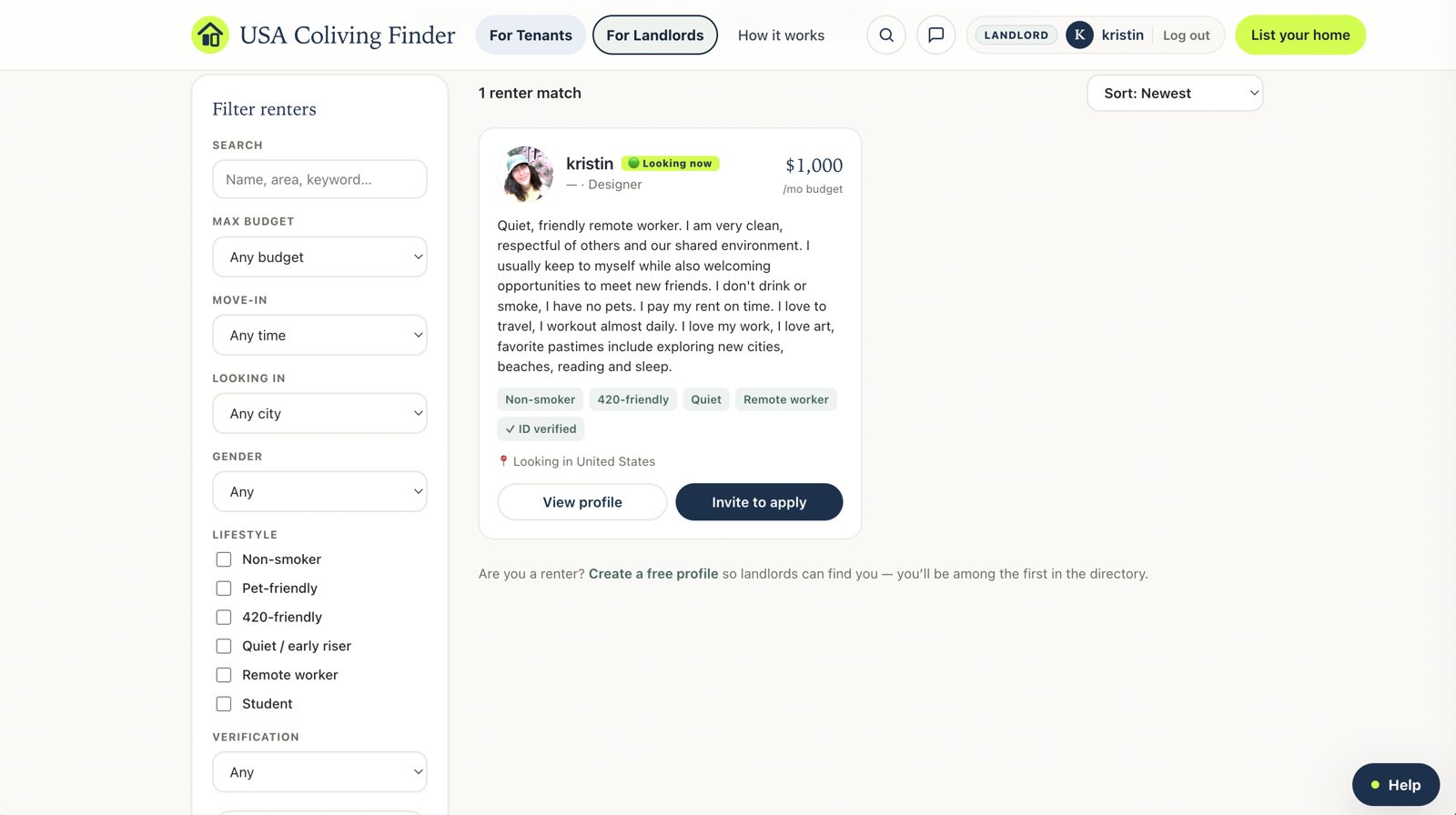
Six screens from the live front-end, each with the design decision behind it. See them in context at usacolivingfinder.com.
Inclusive by default, on any screen
WCAG-AA contrast
Text/background pairs meet AA; lime is an accent on navy, never small text on white.
Filters for how people actually live
Non-smoker, pet-friendly, quiet or early riser, remote worker, student, and a gender preference for the household — compatibility designed into search, not bolted on.
Keyboard & focus
Designed for keyboard use with visible focus states, including the filters and two-pane views.
Mobile-first & responsive
Designed mobile-first — where most relocating renters browse — with two-pane layouts stacking cleanly on small screens.
Sixteen real people, and what they changed
USA Coliving Finder launched in June 2026 from my own Craigslist and Facebook posts, not search. In four months, sixteen people signed up — eleven renters and four landlords besides me. Small numbers, real people. This is what they changed, in the order it happened.
The price was the deal-breaker
The first three landlords I talked to each said the same thing about the monthly fee. In October I made listing free, forever, and wrote to each of them.
A landlord lost his listing three times on his phone
Each time, the Android browser discarded his text. Within days: edits autosave to the device and restore on reopen; photos upload the moment they're picked; Back steps back instead of leaving the site; tapping outside the editor no longer throws it away. When he still didn't come back, I finished his listing for him so all he has to do is approve it, and wrote day‑1, 3 and 7 reminders for anyone who leaves a draft.
A renter couldn't find her application after she'd applied
On a phone, the dashboard was hidden. Now "My dashboard" is always visible, My applications and My profile live in the phone menu, and acceptance shows a banner with a single next step. Her failed background‑check order the day before exposed a silent database bug — fixed the same day — and watching her wait on a second button nobody knew existed is why the move‑in invoice now appears at Accept, marked "Due now."
What worked without my asking
Five of eleven renters completed ID verification on their own. The one who also completed the background check — Gene — tested the whole flow in exchange for a waived move‑in fee, and lives in the house today.
Still open — and I'd rather say so
Seven of eleven renters stop before finishing a profile, and several said they saw the photos but couldn't find how to apply; I haven't fixed that yet. Publishing a home still requires a description, three inclusions, and house rules; "publish now, fill in later" is the next change. A "How was your experience?" page now exists so I stop learning these things by text message.
What I'd measure next: profile completion rate, draft‑to‑published rate for landlords, and time from first message to application.
A platform built Colorado-first, made to scale
A live, responsive marketplace focused on filling Colorado with verified homes and renters — with a product that works the same in any state.
Next: fill Colorado with verified homes and renters, then grow market by market with the same product, and build the backend against the spec.
What scaling taught me
Constraints are the product
The most valuable constraint was deciding what not to do: no leases, no stepping between the parties, no launching everywhere at once. That clarity turns a product built to scale into one coherent, honest experience.
A design system is a scaling engine
Because the system was built with real tokens and components from the first market, adding a market means adding listings, not redesigning the product. Investing in the system early is what makes scaling possible.
Honesty scales trust
Declining to hand out leases where I can't stand behind them — and saying so plainly — protects users and builds credibility. Restraint is a design decision.